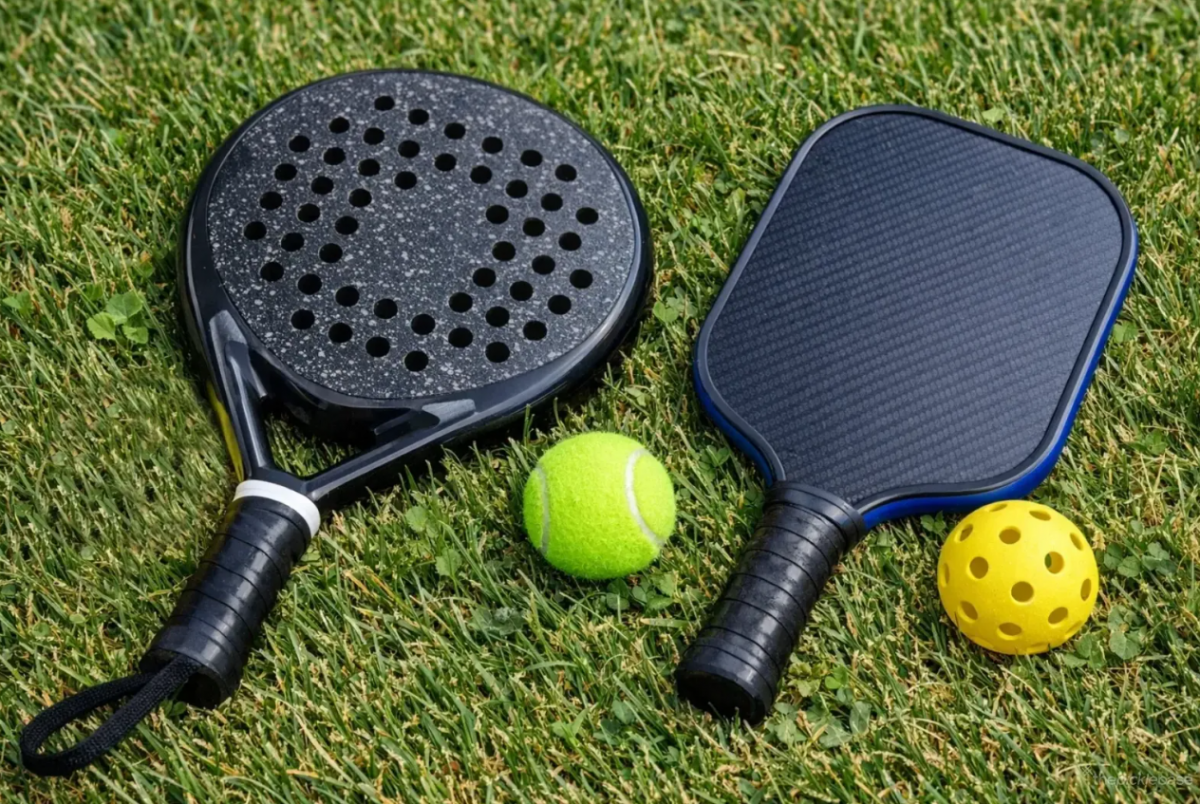
Padel and pickleball have become popular alternatives to traditional tennis. Both use smaller courts and compact rackets or paddles, but the similarities largely end there. Court design, equipment, serving rules, and playing techniques create two distinct experiences.
Padel combines elements of tennis and squash. Players compete inside an enclosed court, using the surrounding walls to extend rallies and recover difficult shots. Pickleball uses an open court, a lightweight plastic ball, and a non-volley zone that shapes play near the net.
These differences affect everything from movement and shot selection to the time beginners need to develop confidence. Understanding how each game works makes it easier to choose between them.
What Are Padel and Pickleball?
Padel originated in Mexico in 1969 before gaining a strong following in Spain and Argentina. It has since expanded across Europe, Latin America, the Middle East, and other regions.
The sport is normally played in doubles on a rectangular court enclosed by glass walls and metal fencing. Players use solid, perforated rackets and pressurized rubber balls designed specifically for padel.
The walls are part of the playing area. A ball that passes a defender may still be returned after rebounding from the back glass, provided it has bounced legally on the court. Reading these rebounds and choosing the right position are essential skills.
Pickleball was invented in Washington State in 1965. Its development drew on elements of tennis, badminton, and table tennis, although the modern game has its own rules and techniques.
Played in singles or doubles, pickleball uses solid paddles and hollow plastic balls with holes. Its court shares the dimensions of a badminton doubles court, but the layout and net specifications differ.
One defining feature is the non-volley zone, commonly called the kitchen. Extending seven feet from the net on each side, this area prevents players from volleying while standing inside it. The restriction creates opportunities for controlled shots, patient exchanges, and sudden attacks.
Padel rewards anticipation, wall awareness, and coordinated doubles movement. Pickleball places particular emphasis on paddle control, shot placement, and quick decisions near the net.
Padel vs Pickleball: Main Differences
The main difference between padel and pickleball lies in how players use the court. Padel’s enclosure allows rallies to continue after certain wall rebounds, while pickleball relies on conventional boundary lines.
The balls behave differently, too. Padel uses a pressurized rubber ball with specific rebound characteristics. Pickleball’s perforated plastic ball loses speed relatively quickly, although powerful drives can still produce fast exchanges.
| Feature | Padel | Pickleball |
| Standard court size | 20 × 10 meters | 20 × 44 feet |
| Court enclosure | Glass walls and fencing | No playable walls |
| Main playing format | Doubles | Singles and doubles |
| Equipment | Solid perforated racket | Solid paddle |
| Ball | Pressurized rubber ball | Perforated plastic ball |
| Serve | Underhand, after a bounce | Volley serve or drop serve |
| Scoring | Tennis-style games and sets | Usually games to 11, win by 2 |
| Special feature | Legal wall rebounds | Non-volley zone and two-bounce rule |
| Tactical emphasis | Lobs, positioning, rebounds | Dinks, placement, controlled volleys |
The contrast is clearest at the net.
In padel, players frequently move forward to establish an attacking position. Opponents respond with lobs that force them toward the back wall, potentially reversing the balance of the rally. Overhead shots, angled volleys, and carefully placed returns help teams regain control.
Pickleball produces a different pattern. Players often approach the non-volley-zone line and exchange soft shots called dinks. The objective is to keep the ball low until an opponent leaves an opening for a faster attack.
Both games reward aggressive play, but players create openings in very different ways.
Padel vs Pickleball Popularity
Padel has a particularly strong presence in Spain and Argentina, with established club networks and professional competition. Italy and several other European countries have also developed substantial playing communities.
Pickleball has grown rapidly in the United States, supported by recreational programs, dedicated facilities, and organized leagues. Its relatively simple court requirements have helped clubs and public facilities introduce the sport.
International comparisons are less straightforward. Participation surveys, registered players, court numbers, and professional audiences measure different aspects of popularity. Strong recreational participation does not necessarily indicate a larger professional following.
Access to courts is another factor behind each sport’s growth. Existing tennis or multipurpose courts can sometimes be adapted for pickleball. Padel requires a specialized enclosure, making new facilities more expensive to construct.
Court Size and Equipment
Court dimensions, playing surfaces, and equipment influence how players move and control the ball. Although both sports use smaller courts than tennis, their layouts create different tactical challenges.
Padel Court Dimensions and Layout
A regulation padel court measures 20 meters long and 10 meters wide, covering 200 square meters. A net divides the playing area, with service lines positioned 6.95 meters from the net on each side.
The net stands 88 centimeters high at the center and 92 centimeters at the ends.
The enclosure combines glass or other approved wall materials with metal fencing. Back enclosures are typically four meters high, consisting of a three-meter wall section topped by one meter of fencing. Side enclosures follow specific configurations under official court regulations.
Artificial turf is a common playing surface, although other approved materials are permitted. Surface texture and sand distribution can influence traction, ball speed, and bounce consistency.
The walls fundamentally change defensive play. Once the ball has bounced in a team’s court, players may allow it to rebound from the surrounding walls before returning it. A shot sent directly into an opponent’s wall without first landing in the opponent’s court is generally a fault.
Pickleball Court Dimensions and Layout
A standard pickleball court measures 20 feet wide and 44 feet long, approximately 6.10 × 13.41 meters. The dimensions are identical for singles and doubles.
The net measures 36 inches at the sidelines and 34 inches at the center.
Each half contains a seven-foot non-volley zone extending from the net. Beyond that area, the court is divided into right and left service courts.
Boundary lines count as in when a ball lands on them, with one important serving exception: a serve that touches the non-volley zone line is a fault.
Outdoor courts commonly feature hard acrylic surfaces. Indoor play may take place on dedicated courts or suitable gym floors. Players also use different ball designs for indoor and outdoor conditions, accounting for factors such as airflow, durability, and surface response.
Padel Racket vs Pickleball Paddle
A padel racket has a solid, perforated hitting surface without strings. Most models use fiberglass, carbon fiber, or other composite materials around a foam or EVA core.
Three common shapes are round, teardrop, and diamond. Their designs influence balance, maneuverability, and the effective hitting area.
Round rackets generally offer accessible handling and control, making them popular with beginners. Teardrop designs often balance power and control, while diamond-shaped rackets tend to favor attacking players comfortable with a higher balance point.
Pickleball paddles have solid hitting faces and relatively short handles. Modern designs commonly combine composite surfaces with polymer honeycomb cores.
Weight, thickness, shape, and surface texture affect how a paddle performs. Lightweight designs can improve maneuverability during rapid exchanges, while longer or differently balanced paddles may offer additional reach or power.
The balls are not interchangeable. Padel balls resemble tennis balls but must meet different pressure and rebound specifications. Pickleballs are hollow plastic balls with holes, designed for contact with a solid paddle rather than a stringed racket.
These equipment differences influence stroke mechanics. Padel requires preparation for rebounds and varied trajectories. Pickleball often favors compact swings, especially when opponents exchange shots at close range.
Rules and Scoring Systems
Padel rules and pickleball rules share basic racket-sport principles: players send the ball over the net, aim for legal landing areas, and try to force an opponent into an error. Their serving procedures, rally restrictions, and scoring formats differ substantially.
Padel Rules and Serving
Padel uses an underhand serve. The server must bounce the ball behind the service line and strike it at or below waist level. At least one foot must remain in contact with the ground when the ball is struck.
Both feet must remain within the permitted serving area, behind the service line and between the imaginary extensions of the center service line and side wall. The server cannot touch the service line or cross the imaginary boundaries with either foot before striking the ball.
The serve travels diagonally into the opposite service box. Players begin each game serving from the right side and alternate sides after every point.
A legal serve must first land inside the correct service box. It may then rebound from the glass wall, but touching the metal fence before a second floor bounce makes the serve a fault.
Servers receive two attempts, as in tennis.
During a rally, the ball may bounce once on a team’s side before being returned. After that bounce, it can contact the team’s own walls without ending the point, provided the return is made before the ball bounces on the floor again.
Players can also strike the ball against their own walls to send it into the opponents’ court. These shots require precise control of angle and direction.
Pickleball Rules and Serving
Pickleball serves travel diagonally from behind the baseline. Under standard USA Pickleball rules, players can use either a volley serve or a drop serve.
For a volley serve, the server must strike the ball below waist level while moving the paddle upward. The highest point of the paddle head must remain below the wrist at contact.
A drop serve follows different mechanics. The player releases the ball without adding force and strikes it after it bounces. The usual volley-serve swing restrictions do not apply.
Both methods require the serve to clear the non-volley zone and land in the diagonally opposite service court.
Pickleball also uses the two-bounce rule. The receiving side must let the serve bounce before returning it. The serving side must then let that return bounce before playing the next shot.
After these two required bounces, players may volley.
The kitchen imposes an additional restriction. Players cannot volley while touching the non-volley zone or its boundary line. A fault also occurs if their momentum carries them into the zone after a volley, even when the ball has already left the paddle.
Entering the kitchen is otherwise legal. Players may step inside to return a ball that has bounced, then reposition for the next exchange.
Padel Scoring
Traditional padel scoring follows the tennis system:
- Points progress through 15, 30, 40, and game.
- At 40–40, advantage scoring requires two consecutive points to win the game.
- A set is normally won by reaching six games with a two-game lead.
- A tiebreak is generally played at 6–6.
- Matches commonly use a best-of-three-sets format.
Some competitions replace traditional advantage scoring with deciding-point formats. Players should check the applicable rules before a match.
The scoring system makes break points particularly important. Winning several rallies does not guarantee a game if a team cannot convert its opportunities at deuce.
Pickleball Scoring
Pickleball games are commonly played to 11 points, with a minimum two-point winning margin.
Under traditional side-out scoring, only the serving side can earn points. If the receiving side wins a rally, it gains or advances toward serving rather than adding a point.
In doubles, scores are announced using three numbers: the serving team’s score, the receiving team’s score, and the server number.
For example, 5–3–2 means the serving team has five points, the receiving team has three, and the second server is serving.
At the beginning of a doubles game, the first serving team has only one server before a side-out. The opening score is therefore announced as 0–0–2.
Some competitions use rally scoring, which allows either side to score on a rally. Games may also be played to 15 or 21 points, depending on the format.
Physical Demands and Difficulty
Padel and pickleball can both be approachable at a recreational level and physically demanding in competition. They demand different movement skills, and a player’s sporting background can make one feel easier than the other.
Physical Demands of Padel
Padel involves repeated accelerations, lunges, changes of direction, and overhead movements. Players regularly move between defensive positions near the back wall and attacking positions closer to the net.
Reading a rebound can require a player to retreat, turn, and reposition before making contact. Poor positioning may turn an otherwise manageable shot into a difficult recovery.
Doubles partners divide court coverage, but frequent transitions between attack and defense can still make rallies demanding.
The sport places particular stress on the shoulders, elbows, knees, and ankles. Overhead strokes involve repeated upper-body loading, while sudden directional changes challenge lower-body stability.
Beginners often find court positioning harder than the basic strokes. Learning when to move backward, when to let the ball reach the glass, and how to recover toward the net takes practice.
Physical Demands of Pickleball
Pickleball involves short lateral movements, quick reactions, lunges, and frequent changes of pace.
In doubles, players often spend much of a rally near the non-volley-zone line. Fast exchanges at this distance demand compact paddle preparation, balance, and accurate contact.
Recreational doubles can involve less sustained running than many other court sports. Competitive play is another matter.
Singles requires players to cover the full width of the court alone, creating greater running demands. Advanced doubles emphasizes explosive reactions, rapid changes of direction, and repeated acceleration during attacking exchanges.
The smaller court does not eliminate injury risks. Sudden stops, awkward reaches, and repetitive paddle movements can stress the lower limbs and upper body.
Suitable footwear, progressive conditioning, and sound movement technique help players manage these demands in either sport.
Which Sport Requires More Technical Skill?
Padel presents a distinctive challenge because players must predict how the ball will rebound from the walls. Successful play combines this awareness with lobs, overhead shots, defensive positioning, and coordinated movement between partners.
Pickleball demands precise control over shot height, depth, and pace. A dink that sits too high can invite an immediate attack. An aggressive drive struck without sufficient control may travel beyond the baseline.
Advanced players must also recognize when to maintain a patient exchange and when to accelerate the ball. Transitions between defensive resets and attacking shots are particularly important.
Players familiar with tennis may adapt quickly to certain padel strokes and scoring conventions. Squash experience can help with reading rebounds. Pickleball often allows newcomers to establish basic rallies sooner, but competitive success requires its own specialized skills.
Which Sport Is Easier for Beginners?
Pickleball often provides an easier starting point for people with no racket-sport experience. Its smaller court and lack of wall rebounds simplify the first few sessions. Beginners can concentrate on basic strokes and positioning before learning more advanced tactics.
The early challenges usually involve keeping returns deep, controlling soft shots, and remembering the kitchen restrictions. Once these fundamentals become familiar, players can work on more deliberate shot placement and transitions toward the net.
Padel introduces an additional learning challenge through its walls. Beginners must judge when to strike the ball directly and when to wait for a rebound. Still, its underhand serve and doubles format allow new players to participate without mastering every advanced technique.
Pickleball may suit beginners who:
- Want to learn the basic rules and begin rallying quickly.
- Prefer a smaller court without wall rebounds.
- Enjoy placement, paddle control, and close-range exchanges.
- Have access to public courts or recreational programs.
Padel may appeal more to players who:
- Enjoy doubles teamwork and coordinated movement.
- Want to develop defensive and attacking shot variety.
- Find wall rebounds, lobs, and overhead play interesting.
- Prefer frequent transitions between the back of the court and the net.
Access to coaching and regular playing partners can matter more than the theoretical difficulty of either sport. A nearby club with beginner sessions may offer a better introduction than an unfamiliar game played without guidance.
FAQ
Is padel harder than pickleball?
Padel often presents a steeper initial learning curve because players must understand wall rebounds and enclosed-court positioning. Pickleball generally allows beginners to start rallying sooner, although advanced play requires precise control, fast reactions, and tactical discipline.
Can you play padel on a pickleball court?
No. A regulation padel court is larger and requires an enclosure with playable walls. Pickleball courts lack the necessary dimensions and structures. The sports also use different nets, markings, and equipment.
Is a padel racket the same as a pickleball paddle?
No. Padel rackets have perforated hitting surfaces and are designed for pressurized rubber balls. Pickleball paddles have solid faces and are used with perforated plastic balls. Their construction, handling, and equipment specifications differ.
Does padel use the same scoring system as pickleball?
No. Padel traditionally uses tennis scoring with points of 15, 30, and 40, followed by games and sets. Pickleball commonly uses games to 11 with a two-point winning margin. Traditional side-out scoring awards points only to the serving side, although alternative formats exist.
Which is more popular, padel or pickleball?
Popularity varies by region. Pickleball has a particularly strong recreational presence in the United States, while padel is firmly established in Spain and Argentina. Both sports have expanded internationally, but participation figures are difficult to compare directly because organizations use different measurements.
Is padel or pickleball better for exercise?
Both provide cardiovascular activity, coordination training, and repeated changes of direction. Padel involves frequent movement between defensive and attacking positions, while pickleball doubles emphasizes short movements and quick reactions. Singles pickleball can require considerably more court coverage. Actual exercise intensity depends on playing level, match format, and individual effort.