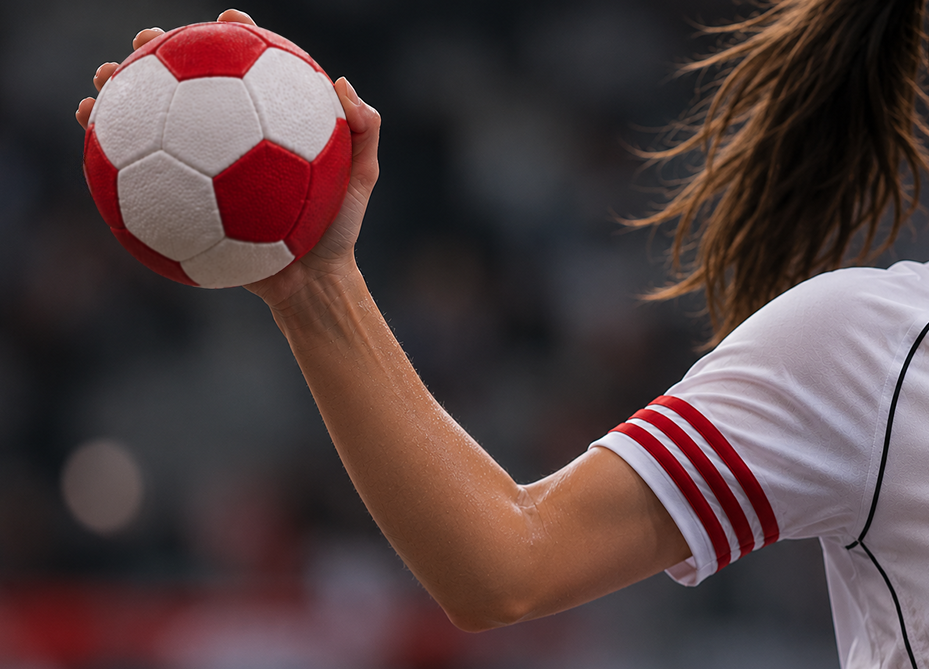
Handball is a fast-paced team sport built around quick passing, physical defense, and accurate shooting. Two teams compete to score by throwing a ball into the opposing goal. Attacks can develop in seconds, and a single turnover can send players sprinting in the opposite direction.
The game shares some features with basketball and soccer, but its rules create a different style of play. Players can pass, dribble, and shoot with their hands, while defenders use positioning and controlled body contact to disrupt attacks. A player may take up to three steps while holding the ball and must pass, shoot, or begin dribbling within three seconds.
Whether you’re watching an international tournament or joining a recreational team, understanding how to play handball makes the action easier to follow. This guide covers the rules, positions, court dimensions, scoring, penalties, and major competitions.
What Is Handball?
Handball, also called team handball or Olympic handball, is an indoor sport played between two teams of seven players, including one goalkeeper per side. The objective is to score more goals than the opposing team before the match ends.
Handball history stretches back to several European games developed during the late 19th and early 20th centuries. Earlier versions included outdoor matches with 11 players, but the seven-a-side indoor format eventually became the international standard. Men’s indoor handball joined the Olympic program in 1972, followed by the women’s competition in 1976.
Today, the International Handball Federation (IHF) governs the sport worldwide, while continental federations oversee regional competitions. Handball has particularly strong traditions in Denmark, France, Germany, Norway, Sweden, and Spain.
How a Handball Game Works
Attacking teams move the ball across the court, looking for gaps in the defense or opportunities to shoot over defenders. When possession changes, players must immediately switch roles. Turnovers can turn a promising attack into a defensive scramble.
A standard senior match consists of two 30-minute halves, separated by a 10-minute halftime under IHF rules. The clock generally runs during ordinary play, although referees stop it for suspensions, team timeouts, and other specified interruptions.
Substitutions are unlimited and can take place during play. Players must use their designated substitution area, and the outgoing player must leave before the replacement enters. Coaches frequently rotate players to maintain intensity, adjust defensive systems, or introduce specialists.
A goalkeeper’s save or intercepted pass can launch a counterattack before the opposing defense is organized. When a quick break is unavailable, teams build a more deliberate positional attack.
Basic Handball Rules
Handball rules govern movement with the ball, physical contact, possession, and access to the goal area. Beginners most often commit violations by taking too many steps, holding the ball too long, or entering the goalkeeper’s area illegally.
The Three-Step and Three-Second Rules
Players may take up to three steps while holding the ball. They must also pass, shoot, or begin dribbling within three seconds.
Dribbling allows players to cover more ground. Once a player catches the ball after dribbling, however, another dribble cannot begin unless the ball has subsequently touched another player or the goal.
The IHF rules effective July 2025 clarify how steps are counted when a player catches the ball while airborne. The initial landing on one foot or both feet simultaneously does not count as a step. Subsequent movements are counted according to the normal stepping rules.
This distinction matters when players receive passes in midair or prepare to shoot after landing.
Passing, Dribbling, and Ball Handling
Players primarily control the ball with their hands and arms, although contact with the head, torso, thighs, and knees is permitted. Playing the ball with the foot or lower leg is generally prohibited, with exceptions such as a ball thrown into a stationary defender’s leg.
Passing helps attackers move defenders out of position. Teams use short combinations, cross-court passes, and changes of direction to create openings.
For example, a backcourt player may draw a defender forward before passing to a teammate moving into the space behind them. The timing of the pass often determines whether the receiver gets a clear shooting opportunity.
The Goal Area Rule
The goalkeeper’s area is enclosed by the six-meter line. Court players cannot enter this area to gain an advantage, although certain entries do not constitute violations.
An attacker may jump from outside the area and release a shot while airborne. The ball must leave the shooter’s hand before the player touches the goal-area line or lands inside. The subsequent landing is permitted when it does not disadvantage the opponents.
A court player may also enter the area after playing the ball if no advantage is gained. Defenders who enter the area to prevent a clear scoring opportunity may concede a seven-meter throw.
Passive Play and Possession
Unlike basketball, handball has no fixed shot clock. Referees can penalize teams that retain possession without making a recognizable attempt to attack or shoot.
A raised arm signals a passive-play warning. After the warning, the attacking team generally has a maximum of four passes to complete an attack with a shot. Referees may penalize passive play earlier if the team continues to delay, while specific interruptions can affect the pass count.
The rule discourages deliberate stalling without imposing the same time limit on every possession.
Handball Court and Equipment
A standard indoor handball court measures 40 meters long and 20 meters wide, approximately 131 by 66 feet. Goals stand at opposite ends, with marked lines regulating shooting positions, free throws, and goalkeeper movement.
Handball Court Dimensions and Markings
The main handball court dimensions are standardized for international competition.
| Court feature | Standard measurement |
| Playing court | 40 × 20 m |
| Goal | 3 m wide × 2 m high |
| Goal-area line | 6 m from the goal |
| Free-throw line | 9 m, dashed |
| Seven-meter line | 7 m from the goal |
| Goalkeeper restraining line | 4 m |
| Central throw-off area | 4 m in diameter |
The six-meter line defines the goalkeeper’s area. The dashed nine-meter line determines where certain attacking free throws must be taken, while the seven-meter line marks the position for penalty throws.
Defenders must generally remain at least three meters from a player taking a free throw. Attackers must also observe positioning restrictions around the free-throw line.
The central throw-off area permits quick restarts after goals. It is required in IHF competitions and senior professional leagues, although other competitions may use the traditional center-line procedure.
Handball Equipment
Basic handball equipment includes a suitable ball, indoor athletic shoes, team uniforms, and a properly marked court with secure goals.
Ball sizes vary by age, sex, and competition category. Traditional IHF classifications include:
- Size 3: Typically used in senior men’s competitions.
- Size 2: Common in senior women’s competitions and older boys’ youth categories.
- Size 1: Generally used by younger players.
Exact dimensions and weights depend on the category, with separate specifications for certain resin-free balls.
Handballs have textured surfaces to improve grip. Some competitions permit approved resin to help players control the ball during passes and shots. Other leagues and facilities restrict its use.
Indoor shoes need reliable traction for sudden changes of direction, jumps, and landings. Goalkeepers may wear additional protective clothing, but dangerous accessories and unauthorized equipment are prohibited.
Player Positions and Their Roles
A standard attacking formation uses six court players and one goalkeeper. Although players regularly exchange positions, each role has distinct tactical responsibilities.
Goalkeeper
The goalkeeper protects the goal and may use any part of the body, including the feet and legs, to stop shots while defending inside the goal area.
Successful goalkeepers rely on reactions, positioning, and anticipation. They study shooters’ approaches, arm movements, and release angles to predict where the ball will travel.
They also contribute to attacking play by delivering long outlet passes after saves or turnovers.
Center Back
The center back, often called the playmaker, organizes the offense. This player directs attacking combinations, controls tempo, and identifies weaknesses in the opposing defense.
Center backs use feints and changes of direction to draw defenders away from teammates. They must also threaten the goal themselves, preventing defenders from concentrating exclusively on passing lanes.
Left and Right Backs
Left and right backs operate on either side of the center back, usually farther from the goal than the wings and pivot.
They frequently attempt long-range shots over defensive blocks or drive through gaps between defenders. Height and throwing power can help, but footwork, timing, and decision-making are just as important.
Backcourt players also create opportunities for the pivot and wings by forcing defenders to shift toward the ball.
Left and Right Wings
Wing players attack from the outer edges of the court, often finishing from narrow angles near the sidelines.
Their role requires acceleration, accurate shooting, and strong jumping technique. A wing may leap toward the goal area to improve the release angle before landing inside it.
Wings also provide width during organized attacks and use their speed to reach open space when possession changes.
Pivot or Line Player
The pivot operates close to the opposing team’s six-meter line, usually between defenders.
Pivots spend much of the game battling for position along the goal-area boundary. They use legal screens, changes of position, and well-timed movements to create passing options or open space for backcourt shooters.
Receiving the ball near the goal leaves little time to react. Strong pivots must catch difficult passes, maintain balance under pressure, and finish quickly.
Defensive Formations
Handball teams use coordinated defensive systems to control space and limit scoring opportunities.
A 6–0 defense places all six court players near the six-meter line. Its compact structure protects the central area and restricts breakthroughs, although opponents may find room for long-range shots.
In a 5–1 formation, one defender moves forward to pressure the attacking backcourt while five teammates remain closer to the goal.
A 3–2–1 defense positions three defenders near the six-meter line, two farther forward, and one in the most advanced position. This creates pressure at several depths and can force turnovers, but it also leaves space behind advancing defenders.
Teams select formations according to their opponents’ strengths, available players, and match situation.
How Scoring Works in Handball
Handball scoring is straightforward. A goal counts when the entire ball crosses the goal line between the posts and beneath the crossbar, provided no attacking violation has occurred.
Every goal is worth one point. A long-range attempt counts the same as a close-range finish or a successful seven-meter throw.
Common Shooting Techniques
Players use different shooting techniques depending on their position, available space, and defensive pressure.
- Jump shot: The shooter leaps above or around defenders and releases the ball before landing. Common among backcourt players.
- Standing shot: A throw taken without jumping, often when the shooter has a clear opening.
- Wing shot: A shot from a narrow angle, frequently taken while jumping toward the goal area.
- Spin shot: A technical finish that uses ball rotation to alter its movement after bouncing.
- Fast-break finish: A shot following a rapid counterattack, often with limited defensive pressure.
A well-placed shot can beat a goalkeeper without overwhelming speed. Players read the goalkeeper’s position, disguise their intended target, and choose between high, low, near-post, and far-post finishes.
Seven-Meter Throws
A seven-meter throw is awarded when an illegal action destroys a clear scoring opportunity.
The shooter must take a position behind the seven-meter line, within the permitted distance, and release the ball within three seconds of the referee’s whistle.
The goalkeeper may move forward but cannot cross the four-meter restraining line before the ball leaves the shooter’s hand.
Not every foul near the goal results in a seven-meter throw. The deciding factor is whether the violation prevented a clear chance to score.
Winning, Draws, and Overtime
The team with more goals at the end of regulation wins. League matches may finish in a draw, depending on competition rules.
Knockout matches requiring a winner can proceed to overtime. Under the standard IHF procedure, the first overtime period consists of two five-minute halves separated by a one-minute break.
If the teams remain tied, a second overtime period may follow. Competition regulations determine whether a seven-meter shootout is required afterward.
Common Fouls and Penalties
Physical contact is part of handball, particularly when defenders contest space near the goal. The rules distinguish legal defensive positioning from actions that unfairly restrict or endanger opponents.
Referees consider the type of contact, the defender’s position, and its effect on the attacking player.
Common Handball Fouls
Frequent violations include:
- Holding: Grabbing an opponent or their uniform to restrict movement.
- Pushing: Using illegal force to displace an opponent.
- Illegal blocking: Using extended arms, legs, or prohibited contact instead of legal body positioning.
- Steps: Exceeding the permitted number of steps while holding the ball.
- Double dribble: Restarting a dribble without a qualifying intervening touch.
- Illegal goal-area entry: Entering the six-meter area and gaining an advantage.
- Passive play: Failing to make a genuine attacking attempt.
Technical violations generally result in a free throw or another appropriate restart. More serious offenses may also lead to disciplinary punishment.
Free Throws
A free throw is the usual restart after a violation that does not require a seven-meter throw or another specific restart.
When a foul occurs near the opposing goal area, the attacking team’s free throw is generally taken outside the nine-meter dashed line.
Players must observe the required positioning rules, including the minimum distance between the thrower and opposing defenders.
Quick free throws can catch defenders out of position, provided the conditions for restarting play have been met.
Yellow Cards and Two-Minute Suspensions
Referees use progressive punishment for many forms of illegal contact and unsportsmanlike conduct.
A yellow card serves as a warning. An individual player may receive only one warning, and a team can receive no more than three player warnings in total. Serious violations may justify an immediate suspension without a previous warning.
A two-minute suspension temporarily reduces the number of players a team may field. The suspended player cannot be replaced until the suspension period expires.
Teams playing shorthanded often prioritize controlled possession and compact defensive positioning.
Red Cards and Disqualification
A red card disqualifies a player or team official from further participation in the match.
Dangerous fouls and serious unsportsmanlike conduct may result in immediate disqualification. A player’s third two-minute suspension also leads to a red card.
Following a player disqualification, the team generally plays with one fewer player for two minutes before an eligible substitute can restore its numbers.
A blue card, shown after a red card, indicates that the referees will submit a written report for possible further disciplinary action.
Under the IHF rules effective July 2025, certain direct shots striking the goalkeeper’s head can result in a two-minute suspension. These provisions concern specific situations involving seven-meter throws and unhindered open-play shots. The applicable sanction depends on the circumstances, including whether the goalkeeper’s movement contributed to the contact.
Handball Competitions and Tournaments
The international handball calendar includes Olympic tournaments, world championships, continental competitions, and professional club leagues.
Olympic Handball
Indoor handball is part of the Summer Olympic program. Men’s competition debuted in 1972, followed by women’s handball in 1976.
National teams qualify through designated continental and international pathways.
Olympic tournaments demand squad depth and effective player rotation, as teams face physically demanding matches with relatively short recovery periods.
IHF World Championships
The IHF organizes separate men’s and women’s World Championships, normally held every two years.
These tournaments bring together national teams from multiple continents, allowing different playing styles and tactical approaches to compete at the highest level.
Qualification systems determine which countries reach the final tournaments, while the competition format establishes the path to the championship title.
European Championships
The European Handball Federation (EHF) organizes the men’s and women’s European Championships, commonly known as EHF EURO.
European competition is particularly strong because many leading national teams draw players from established professional leagues.
Teams advance through qualification before competing in the final tournament. Results can also affect qualification pathways for other major international events.
Professional Club Handball
Professional handball is especially prominent in Europe. Germany’s Handball-Bundesliga, France’s top division, and Denmark’s domestic leagues are established destinations for elite players.
At continental level, the EHF Champions League brings together leading European clubs in separate men’s and women’s competitions.
Unlike national teams, clubs train and compete together throughout an extended season. Coaches can therefore develop detailed tactical systems and adjust them over months of domestic and international competition.
FAQ
How many players are on a handball team?
Seven players from each team may be on the court at once, normally six court players and one goalkeeper. Substitutes enter through the designated substitution area. Teams may also temporarily replace their goalkeeper with an additional court player during an attack.
How long does a handball match last?
A standard senior match lasts 60 minutes, divided into two 30-minute halves. Halftime is normally 10 minutes under IHF rules, although competition regulations may allow a longer interval. Youth matches generally have shorter playing times.
Can you kick the ball in handball?
Court players cannot deliberately play the ball with their feet or lower legs. Contact with other permitted body parts, including the knees and thighs, is legal. Goalkeepers may use their feet to stop shots while defending inside their goal area.
What happens if a player takes more than three steps?
Taking too many steps while holding the ball is a technical violation. The opposing team receives a free throw. Players avoid this by passing, shooting, or dribbling within the permitted movement limits.
What is the difference between handball and beach handball?
Indoor handball uses seven players per team on a hard court. Beach handball is played on sand with four players per side on the playing area. Beach handball also awards two points for certain spectacular goals and uses a different system for determining match winners.
Is handball a contact sport?
Yes. Defenders may use controlled body contact to contest positions and disrupt attacks. Grabbing, pushing, striking, and dangerous challenges are prohibited. Depending on the violation, referees may award a free throw, a suspension, or a disqualification.